


It’s tough out there.
New attack vectors hitting businesses left and right, AI disrupting the industry, shrinking budgets—we could keep going.
To cover all your bases, you need a comprehensive cybersecurity strategy, and every holistic approach needs to include both firewalls and antivirus software working together to defend against cyber threats.
These essential tools serve different but complementary security functions, providing layered protection against both external threats and internal vulnerabilities.
Let’s see how these two forces work together to protect your environment.
Key Takeaways
- Firewalls block external threats at the network level while antivirus software detects malicious programs that have already entered your systems
- Firewalls control network traffic and prevent unauthorized access, while antivirus solutions identify and remove malware using signature-based detection and behavioral analysis
- Modern NGFWs integrate multiple security features like intrusion prevention systems and deep packet inspection for comprehensive threat prevention
- Professional network assessments identify vulnerabilities and ensure your firewall and antivirus solutions are properly configured for your specific business needs
What is a Firewall?
A firewall is a network security system that acts as a protective barrier between trusted internal networks and untrusted external networks.
Firewall technology serves as your first line of defense by controlling network traffic and monitoring incoming and outgoing traffic based on predetermined security rules.
Modern firewall software examines data packets, analyzes IP addresses, and makes real-time decisions about blocking unauthorized access to your network infrastructure.
Firewalls protect your organization by filtering traffic at the network level and examining network packets before they enter your internal network. This process involves deep packet inspection, where the firewall analyzes not just packet headers but also the actual content of network connections.
By implementing specific security rules, firewalls serve as gatekeepers that control access to your computer systems and prevent unauthorized network access from external networks.
Types of Firewall Solutions
There are a couple of types of firewall solutions on the market:
- Hardware Firewalls provide dedicated network security at the infrastructure level, offering robust protection for entire networks. These enterprise-grade security tools typically handle high-volume network traffic more efficiently than software-based solutions.
- Software Firewalls operate on individual computer systems, providing host-based protection that complements network-level security. These solutions excel at monitoring outgoing network traffic and controlling network connections at the device level.
You can also have Firewall as a Service, which delivers cloud-based firewall protection, offering scalable security measures without the need for on-premises hardware management.
Key Firewall Benefits
Firewalls offer organizations several security benefits:
- Enhanced Network Security - Firewalls act as intelligent barriers, blocking unauthorized access attempts and filtering malicious traffic before it reaches your internal systems
- Granular Access Control - Advanced firewall rules provide precise control over network connections, allowing security teams to define specific security rules for different types of network traffic
- Network Segmentation - Modern firewalls support network segmentation strategies, isolating critical systems and limiting the potential impact of security breaches
- Traffic Monitoring - Comprehensive monitoring of incoming and outgoing network traffic enables early detection of suspicious activities and potential routing attacks
Your firewall is essentially your company’s digital security guard—tracking the comings and goings of people and activities in your network.
What is a Next-Generation Firewall?
A Next-Generation Firewall (NGFW) represents advanced firewall technology that merges traditional packet filtering capabilities with additional network security features. NGFWs provide enhanced security through integrated intrusion prevention systems, application awareness, and advanced threat detection capabilities.
Examples of advanced security features in next-generation firewalls include:
- Sandboxing for unknown file analysis
- Content filtering and URL categorization
- SSL inspection for encrypted traffic
- Virtual Private Network (VPN) integration
- Advanced malware protection
- Intrusion prevention systems
- Network-based antivirus protection
NGFWs perform comprehensive analysis on network traffic flows, utilizing deep packet inspection and behavioral analysis to detect malicious activity more quickly and accurately than traditional firewalls. This enhanced threat prevention capability makes them more effective at preventing intrusions, data breaches, and sophisticated cyber attacks. The additional security layers provided by NGFWs help ensure comprehensive protection from multiple attack vectors.
Here's a video from our strategic partner, Fortinet, explaining the benefits of NGFWs.
What is Antivirus Software?
Antivirus software is specialized security software designed to detect, prevent, and remove malicious software from computer systems.
Modern antivirus solutions protect against various types of harmful software, including computer viruses, worms, trojans, ransomware, and other malicious programs that can compromise system security and performance.
Antivirus programs work by maintaining extensive databases of malware signatures and virus definitions that help identify known threats. When antivirus software detects suspicious files or activities, it can quarantine infected files, remove malicious programs, and prevent the spread of harmful software across your network infrastructure.
How Antivirus Software Works
Modern antivirus tools employ multiple detection methods to identify and neutralize threats:
- Signature-Based Detection uses known malware signatures to identify previously catalogued threats. Antivirus software maintains updated virus definitions that allow it to recognize specific patterns associated with malicious programs.
- Heuristic Analysis examines file behavior and characteristics to identify potentially harmful software that doesn't match known malware signatures. This proactive approach helps detect new and evolving threats.
- Real-Time Protection continuously monitors system activity, scanning files as they're accessed, downloaded, or executed. This ongoing surveillance ensures immediate detection of malicious activities.
- Cloud-Based Analysis leverages remote threat intelligence databases to identify emerging threats and provide rapid response to new malware variants.
The type that will work best for you depends on your organization, industry, threat levels, data, and more.
Key Antivirus Benefits:
Antivirus security systems bring several cybersecurity benefits to businesses.
Some of the most important include:
- Proactive Threat Detection - Antivirus software detects malicious activities on your computer systems before they cause significant damage, utilizing both signature-based detection and behavioral analysis
- Comprehensive Malware Removal - Advanced antivirus solutions can effectively remove various types of malicious software, including rootkits, trojans, and other persistent threats
- Real-Time System Protection - Continuous scanning capabilities ensure ongoing protection against the latest threats without significantly impacting system performance
Additionally, antivirus software has automated updates. Regular updates to virus definitions and malware signatures keep your antivirus protection current against emerging threats.
Firewall vs Antivirus Software: Understanding the Differences
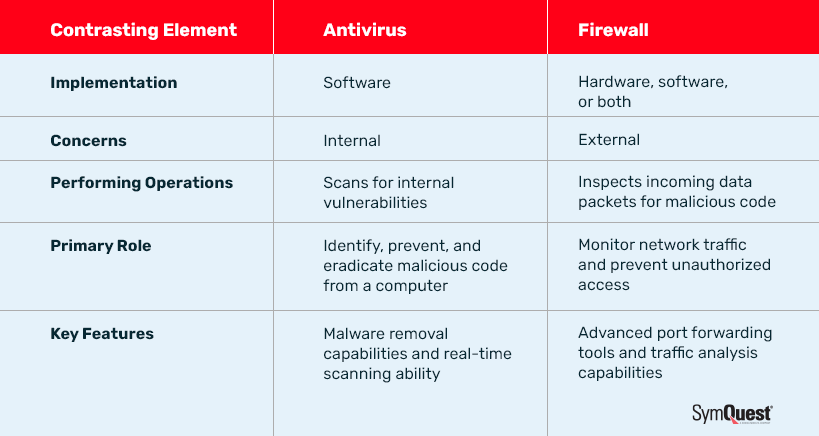
The fundamental difference between antivirus and firewall software lies in their security functions and protective scope. While both are essential security tools, they address different aspects of cybersecurity and complement each other in a comprehensive security strategy.
Scope of Protection
Firewalls focus on network-level security, controlling network traffic between your internal network and external networks. Firewalls serve as network gatekeepers, analyzing data packets and network connections to prevent unauthorized access attempts. They excel at blocking external threats before they reach your computer systems.
Antivirus Software operates primarily at the system level, focusing on detecting and removing malicious software that has already entered your computer systems. Antivirus programs specialize in identifying infected files, malicious programs, and other harmful software that may have bypassed network-level defenses.
Protection Methods
Firewall Technology uses packet filtering, deep packet inspection, and access control mechanisms to evaluate network traffic against predetermined security rules. Firewalls analyze IP addresses, port numbers, and communication protocols to make access decisions.
Antivirus Functionalities rely on malware signatures, heuristic analysis, and behavioral monitoring to identify threats. Antivirus tools maintain extensive databases of known malware signatures and use advanced algorithms to detect suspicious activities.
Threat Focus
Firewalls primarily defend against:
- Unauthorized network access from external sources
- Malicious traffic attempting to exploit network vulnerabilities
- Routing attacks and network-based intrusions
- Unauthorized access attempts to specific network resources
Antivirus Solutions specifically target:
- Computer viruses and worms
- Trojans, ransomware, and spyware
- Infected files and malicious downloads
- Internal threats from compromised systems
Why Both Firewalls and Antivirus Software Are Essential Security Tools
Modern cyber threats require a multi-layered approach to cybersecurity. Relying solely on either firewall software or antivirus programs leaves significant security gaps that cybercriminals can exploit.
Complementary Security Functions
The relationship between firewalls and antivirus software creates a powerful security ecosystem where each tool strengthens the other's capabilities.
Firewalls establish secure network perimeters by controlling incoming and outgoing traffic based on specific security rules, creating your first line of defense that prevents many external threats from reaching your computer systems.
Network-level protection via firewalls works seamlessly alongside antivirus software, which provides essential protection for individual devices and systems, detecting malicious software that may have bypassed network security measures or originated from internal sources.
This layered defense strategy transforms your cybersecurity posture from a single point of protection into multiple security layers that address different threat vectors and attack methods.
Addressing Different Threat Categories
The complementary nature of these security tools becomes most apparent when examining how they handle different categories of cyber threats.
Firewalls excel at blocking external threats by controlling access from untrusted external networks and preventing unauthorized network access attempts from internet-based attackers.
However, cyber threats don't always originate from external sources, which is where antivirus software becomes crucial for detecting internal threats. These internal security risks include infected files introduced through removable media, malicious email attachments that bypass initial network filters, or compromised internal systems that have been infiltrated through social engineering attacks.
The distinction between known and unknown threats further illustrates why both security tools are essential. While antivirus programs are highly effective against known threats with established malware signatures, they may struggle with completely new attack variants.
Firewalls complement this capability by blocking unknown threats based on network behavior and access patterns, providing protection even when specific malware signatures haven't been identified or distributed to antivirus databases.
Firewalls and Antivirus Software: A Holistic Approach to Cybersecurity
Combining firewalls with antivirus software creates a holistic cybersecurity approach that provides comprehensive protection against both external and internal threats.
The synergy between firewall and antivirus technologies creates multiple security layers that complement each other's capabilities. Firewalls protect the network perimeter and control traffic flow, while antivirus solutions provide deep system-level protection against malicious software.
Organizations interested in reducing their attack surface and implementing comprehensive cybersecurity solutions should request a network assessment from an experienced managed security provider, like SymQuest, today.